
What sits under the shingles
Roof Ventilation & Underlayment in Rosharon, TX
An attic reading 140 degrees in July and shingles that aged out five years early is a ventilation problem, not a shingle problem. Re-roofing without fixing it just restarts the same clock.
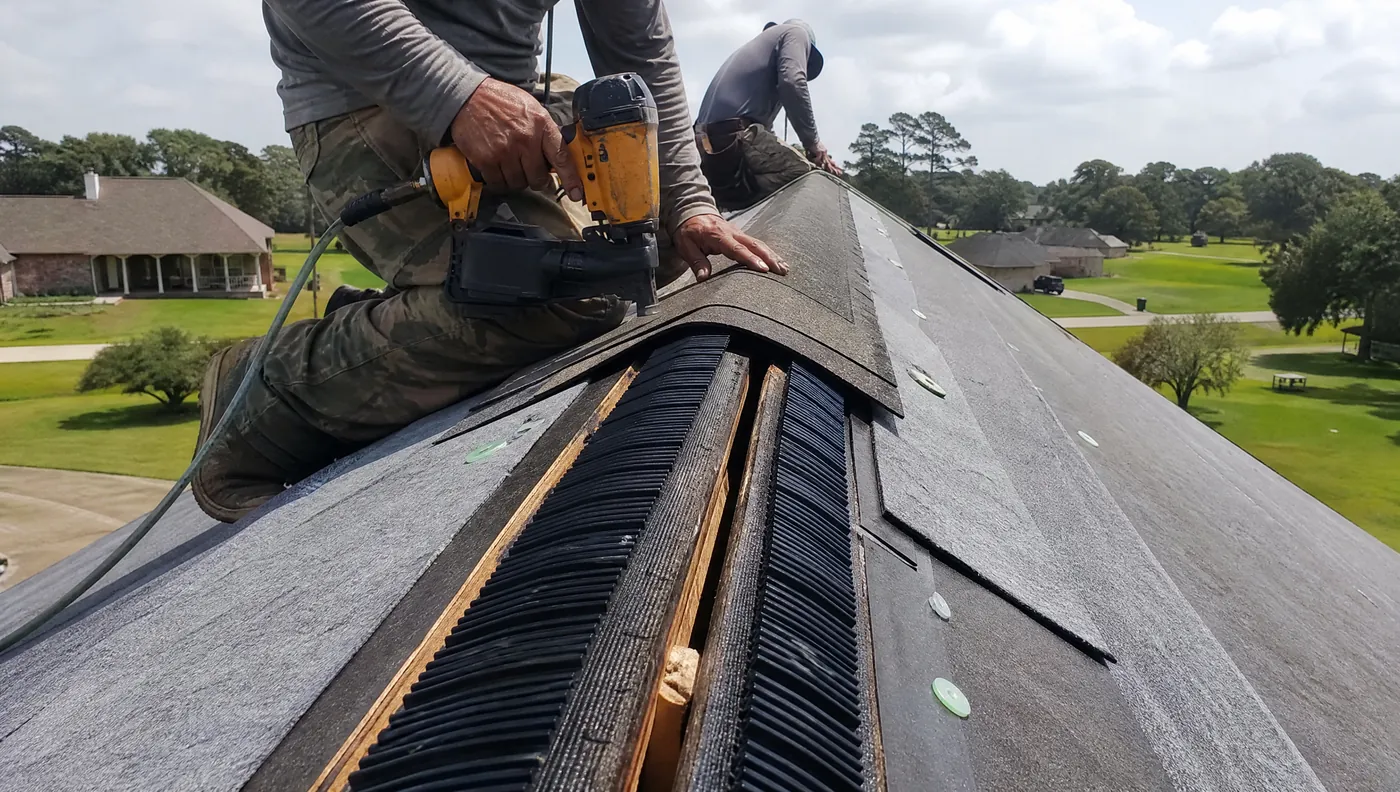
Roof ventilation works as a pair. Cool air enters low, at the soffit, and hot air leaves high, at the ridge. Both halves have to be open for either to do anything, and the failure we find most often in this area is a house with a perfectly good ridge vent and soffit baffles stuffed solid with blown insulation. That roof is exhausting through nothing.
The consequences are all quiet and all expensive. Shingles cook from underneath and reach the bottom of their life expectancy instead of the top. Attic temperature drives cooling load up through a Rosharon summer. Moisture that should be leaving condenses on the underside of the decking instead, which delaminates sheathing and, in bad cases, grows things. And most manufacturer warranties are void where ventilation does not meet their specification, which almost nobody reads until they try to claim.
What balanced ventilation looks like
- Intake at the soffit, vented panel with clear baffles behind it so the insulation cannot block the airway.
- Exhaust at the ridge, a continuous cut ridge vent rather than a handful of box vents, which move far less air for the same money.
- Roughly balanced areas, with intake at least equal to exhaust. Exhaust larger than intake makes the system pull air from inside the house, which is worse than doing nothing.
- No mixing of exhaust types. Ridge vent plus powered fans plus turbines on the same roof short-circuit each other and the fan just pulls air in through the ridge vent three feet away.
Are powered attic fans worth it here?
Rarely, and they are frequently counterproductive. A powered fan on a house with inadequate soffit intake pulls conditioned air out of the living space through every ceiling penetration, so you are air-conditioning the attic. On a house with adequate intake, passive ridge and soffit ventilation already moves enough air and the fan is buying electricity. Solar-powered versions remove the running cost and not the underlying problem. Fix the intake first and then see whether you still want one.
| Item | Price | What it does |
|---|---|---|
| Continuous ridge vent, per linear ft | $9 to $18 | The exhaust half. Cut and installed during a re-roof |
| Soffit vent panel, per linear ft | $14 to $30 | The intake half, and the half that gets skipped |
| Baffles to clear blocked intake, per bay | $18 to $35 | Stops insulation choking the airway |
| Synthetic underlayment, per square | $18 to $32 | Replaces felt. Does not tear or wrinkle |
| Ice-and-water membrane, per square | $45 to $85 | Valleys, penetrations and eaves. The wind-driven-rain layer |
| High-temp underlayment for metal, per square | $35 to $60 | Rated for the deck temperatures under metal panel |
| Turbine or box vent removal and patch | $120 to $260 each | When converting to a ridge system |
Prices collected July 2026 for the Rosharon and north Brazoria County area. All of these are far cheaper as part of a re-roof than as standalone work.
Underlayment: what actually goes under a Rosharon roof
Synthetic underlayment across the whole field. It does not tear when wind gets under it during the install, it does not wrinkle when it gets wet, and it walks better, which matters for the crew's safety on a steep roof. Felt is cheaper and it is a false economy on this coast.
Self-adhering ice-and-water membrane goes in every valley, around every penetration and along the eaves. The name is misleading in Texas, where nobody is worried about ice dams. What it does here is seal around fasteners and hold out wind-driven rain at exactly the details where wind-driven rain gets in, which is the failure mode this county actually has.
Ventilation and the windstorm certificate
Ridge vent on a certified roof has to be a product with a current TDI evaluation for the wind zone, installed to it. External baffles on cheap ridge vent are also a common wind-driven-leak source, which is why a roof can be watertight in vertical rain and leak the moment the wind comes out of the south. See the WPI-8 page.
How do I tell whether my attic is ventilated properly?
Go into the attic on a hot afternoon and put your hand near the soffit at the eave. If you feel no air movement at all, the intake is blocked, and that is the answer. Two other tells, from inside the house: shingles that have aged noticeably faster on one slope, and a cooling system that struggles disproportionately in the afternoon. From outside, a roof deck that looks wavy between rafters usually means the sheathing has been delaminating from moisture underneath.
Can ventilation be fixed without re-roofing?
Partly. Soffit venting, baffles and box vent work can all be done without touching the field of the roof. A continuous ridge vent needs the ridge opened up, which is straightforward on its own but genuinely cheap during a tear-off when the crew is already there. If a re-roof is anywhere in the next three years, the right answer is almost always to fix the intake now and do the ridge with the roof.
Where we do this work
Ventilation work throughout the service area, most often as part of a re-roof where the cost of doing it properly is marginal.
Ventilation & Underlayment in Iowa Colony, Arcola ventilation & underlayment, Ventilation & Underlayment for Manvel properties, Ventilation & Underlayment in Fresno, Sienna ventilation & underlayment, Ventilation & Underlayment for Brookside Village properties, Ventilation & Underlayment in Pearland, Alvin ventilation & underlayment, Ventilation & Underlayment for Missouri City properties, Ventilation & Underlayment in Damon, Angleton ventilation & underlayment, Ventilation & Underlayment for Danbury properties, Ventilation & Underlayment in Liverpool.
Related: Roof Replacement & Tear-Off · Gutters, Soffit & Fascia · Asphalt Shingle Roofing · Roof Maintenance & Coatings
Attic like an oven and shingles ageing early?
Free attic and roof check. Ventilation problems are cheap to find and cheap to fix.
Call (281) 845-8668- A roofer answers, not an answering service
- Written line-item scope before any work starts
- We never touch your deductible, and Texas law is why
Have a doubt
Ventilation and underlayment questions
How much does roof ventilation cost?
Continuous ridge vent costs $9 to $18 per linear foot and soffit venting $14 to $30 per foot, installed. On a typical Rosharon house a full balanced ventilation upgrade during a re-roof is usually $700 to $1,800, and it is one of the better dollars on the job.
Do I need ridge vents if I already have turbines?
Not both. Mixing exhaust types on the same roof makes them short-circuit each other, so a turbine ends up pulling air in through a ridge vent a few feet away rather than from the soffit. Pick one system. Continuous ridge vent moves more air than the equivalent spend on turbines and there is nothing to seize up.
What is ice and water shield for in Texas?
Wind-driven rain, not ice. The self-adhering membrane seals around fasteners and holds water out at valleys, penetrations and eaves, which are exactly the details that fail when rain arrives sideways in a Gulf storm. The name is a northern-climate hangover.
Is felt underlayment good enough?
It meets code and it is what we would use last. Felt tears when wind gets under it mid-install, wrinkles when it gets wet and telegraphs those wrinkles through the finished shingle. Synthetic costs $18 to $32 a square more and removes all three problems.